
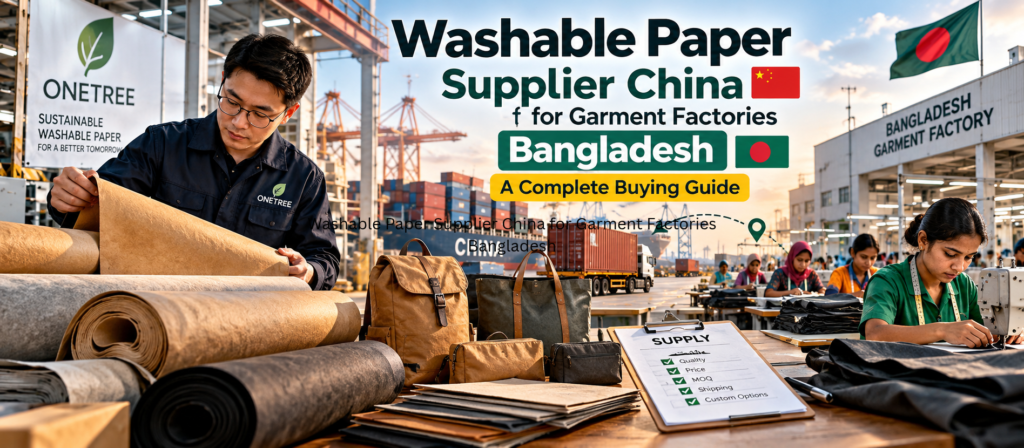
Did you know a single garment factory can use thousands of paper tags, labels, and bags every day, and most of that paper ends up in the trash?
If you run or buy for a factory in Dhaka, Gazipur, Ashulia, or Narayanganj, you see this every day. Hang tags, packing paper, patches, and labels pile up fast. Much of it is virgin paper made from trees.
There is a better option. Washable paper looks like leather, feels like fabric, and survives the wash. It also cuts demand for plastic and virgin paper. The challenge is finding a reliable washable paper supplier China for garment factories Bangladesh buyers can trust.
This guide shows you how. You will learn what washable paper is, why it matters for the environment, and how to vet suppliers step by step. You will also see how OneTreePaper supports tree-saving, sustainable paper solutions.
What Is Washable Paper?
Washable paper is a strong, flexible material, usually made from cellulose fibers (wood pulp) with a special treatment. Many people call it washable kraft paper. It looks like paper but behaves more like soft leather or heavy fabric.
You can sew it, cut it, print on it, and wash it. It does not tear easily. It softens over time and gains a natural, worn-in look.
Common Uses in Garment Factories
You can use washable paper for:
- Brand labels and patches
- Hang tags and care labels
- Waistband and pocket labels
- Tote bags and shopping bags
- Storage and packing bags
- Accessories such as belts and wallets
- Decorative trims on denim and casual wear
How It Differs From Regular Paper
| Feature | Regular Paper | Washable Paper |
|---|---|---|
| Water resistance | Very low | Medium to high |
| Can be sewn | No | Yes |
| Survives washing | No | Yes (varies by grade) |
| Feel | Stiff | Soft, leather-like |
| Typical lifespan | Single use | Multiple uses |
| Plastic replacement | No | Yes, in many cases |
Ask each supplier for wash-test data. Grades differ, and results depend on the fiber blend and coating.
Why Bangladesh Garment Factories Use Washable Paper
Bangladesh is one of the world’s largest garment exporters. Ready-made garments make up most of the country’s export income. That scale means small material choices add up quickly.
Pressure From Global Buyers
International brands now ask for greener trims and packaging. Many buyers in Europe and North America set sustainability targets for their suppliers. If your factory offers eco friendly paper options, you meet those targets and gain an edge.
Cost and Performance Benefits
Washable paper is often cheaper than leather patches. It is lighter than many plastic alternatives. It also prints well, so brands can add logos and designs easily.
A Growing Green Reputation
Bangladesh has become known for green factories. Many are certified under global green building standards. Using sustainable paper products fits that image and supports your factory’s ESG story.
The Environmental Impact of Paper in Garment Supply Chains
Paper seems harmless. But the environmental impact of paper is large when you look at the full cycle.
From Forest to Factory
Making virgin paper starts with cutting trees. Forests store carbon, protect soil, and shelter wildlife. When forests shrink, those benefits shrink too.
Then comes pulping and bleaching. These steps use large amounts of water and energy. Some processes release chemicals into rivers and air.
Where Garment Factories Add to the Problem
Factories create paper waste in many places:
- Hang tags and labels thrown away after one use
- Cartons and tissue paper for packing
- Pattern and marker paper used in cutting rooms
- Office paper for orders and reports
- Sample packaging shipped to buyers
The Waste Problem in Dhaka
Dhaka already struggles with waste management. Landfills are crowded, and open dumping harms air and water. Every ton of paper you avoid sending to landfill helps.
Paper also releases methane as it breaks down in landfill. Methane is a strong greenhouse gas. Reducing paper waste is a direct way to cut that impact.
“The greenest paper is the paper you never throw away.” This idea drives many sustainable sourcing programs.
Eco Friendly Paper and Recycled Paper Benefits
Switching to better paper is not hard. You just need to know what to look for.
What Makes Paper “Eco Friendly”?
Eco friendly paper usually meets several of these points:
- Made from recycled fibers or responsibly sourced pulp
- Produced with less water and energy
- Free from harmful chemicals
- Reusable, durable, or recyclable
- Backed by credible certifications
Recycled Paper Benefits
The recycled paper benefits go beyond saving trees:
- Fewer trees cut. Recycled fiber replaces some virgin pulp.
- Less energy use. Recycling generally needs less energy than making paper from raw wood.
- Less water use. Many recycled processes use less water.
- Less landfill waste. Used paper gets a second life.
- Lower carbon footprint. Less cutting, transport, and processing adds up.
Exact savings depend on the mill and the process. Ask suppliers for data instead of accepting broad claims.
Certifications to Look For
| Certification | What It Shows |
|---|---|
| FSC (Forest Stewardship Council) | Pulp from responsibly managed forests |
| PEFC | Sustainable forest management chain of custody |
| OEKO-TEX | Tested for harmful substances (for textile-related items) |
| ISO 14001 | Environmental management system at the mill |
| REACH / RoHS compliance | Chemical safety for EU-bound goods |
Ask for certificate copies. Then check the certificate number on the issuing body’s website.
How OneTreePaper Supports Tree-Saving Paper Solutions
OneTreePaper is built around a simple idea: every paper choice affects a tree. The brand promotes tree saving paper and sustainable paper products that help industries use fewer virgin resources.
What OneTreePaper Focuses On
- Eco-conscious materials that reduce reliance on virgin wood pulp
- Durable washable options that last longer than single-use paper
- Tree-saving awareness that helps buyers understand paper’s footprint
- Responsible sourcing from suppliers who value quality and compliance
- Practical guidance for factories that want to reduce paper waste
Why This Matters for Your Factory
When you buy durable paper that lasts through washing and reuse, you cut how often you replace it. Fewer replacements mean less demand for new pulp. That is the core of a tree-saving approach.
OneTreePaper also helps factories tell a clear sustainability story to buyers. You can show that your trims and packaging support a lower-impact supply chain.
Questions to Ask OneTreePaper or Any Partner
- What fiber sources do you use?
- Which certifications can you show?
- How many wash cycles does each grade handle?
- Can you share lab reports?
- How do you support tree conservation efforts?
A good partner answers these openly and in writing.
How to Choose a Washable Paper Supplier in China: Step-by-Step
China is a major source of washable kraft paper. It has large mills, strong printing capacity, and fast production. But quality varies a lot. Use this process to find a washable paper supplier China for garment factories Bangladesh buyers can depend on.
Step 1: Define Your Needs
Before you contact anyone, write down:
- Product type (labels, bags, tags, rolls, sheets)
- Thickness (grams per square meter, or GSM)
- Size and roll width
- Color and finish
- Wash-cycle requirement
- Monthly volume
- Target price
Clear specs save time and prevent wrong quotes.
Step 2: Search Smart
Use these channels:
- B2B platforms such as Alibaba and Made-in-China
- Trade fairs such as the Canton Fair and textile expos
- Referrals from other Bangladesh factories
- Direct mill websites
- Sourcing agents in Guangzhou, Shanghai, or Hangzhou
Shortlist five to eight suppliers. Do not pick one only because the price is lowest.
Step 3: Check Whether You Are Dealing With a Mill or a Trader
| Type | Pros | Cons |
|---|---|---|
| Manufacturer / mill | Better price, direct control, custom options | Higher MOQ, slower start |
| Trading company | Lower MOQ, wider range | Higher price, less control over quality |
Ask for factory photos, videos, and a business license. A live video tour is a strong test. Real mills are happy to show their lines.
Step 4: Verify Credentials
Check these items:
- Business license and registered address
- Export history
- Certifications (FSC, ISO, OEKO-TEX)
- Customer references, especially in South Asia
- Third-party audit reports
You can check Chinese company records through official registries. Do not skip this step.
Step 5: Request Samples
Always order samples first. Ask for the same grade you plan to buy in bulk. Do not accept a “better” sample than the production run.
Step 6: Test the Samples (See Next Section)
Step 7: Negotiate Terms
Discuss:
- Price per kilogram, meter, or piece
- Minimum order quantity (MOQ)
- Payment terms
- Lead time
- Packaging and labeling
- Defect policy and replacements
Step 8: Start With a Trial Order
Place a small order first. Review quality, packing, and delivery. If all goes well, scale up.
Specification Checklist for Washable Paper
Use this table when you compare quotes.
| Specification | What to Ask | Why It Matters |
|---|---|---|
| GSM (weight) | 150-400 GSM typical | Affects strength and feel |
| Wash durability | Cycles at 30-40°C | Confirms real washability |
| Color fastness | Test rating | Prevents bleeding onto fabric |
| Tear strength | Lab value | Stops labels from ripping |
| Print quality | Sample print | Protects brand logos |
| Fiber source | Virgin or recycled | Supports sustainability claims |
| Certifications | FSC, OEKO-TEX, etc. | Needed for buyer audits |
| Chemical safety | REACH/RoHS report | Required for EU markets |
| Lead time | Days to ship | Matches your production plan |
| MOQ | Minimum quantity | Controls cash flow |
How to Test Washable Paper Samples
Never trust a sample sheet alone. Run your own tests.
Simple Factory Tests
- Wash test. Sew the paper onto a fabric swatch. Wash it as you would the finished garment. Repeat several cycles.
- Color test. Wash a white fabric piece with it. Check for staining.
- Sewing test. Run it through your machine. Look for tears or needle damage.
- Print test. Print your logo. Rub and wash it. Check fading.
- Dry test. Air-dry and tumble-dry samples. Look for curling or cracking.
Lab Tests
For export orders, ask a third-party lab to test:
- Colorfastness to washing and rubbing
- Tear and tensile strength
- Restricted chemicals
- pH level
Many buyers will ask for these reports anyway. Having them ready speeds up approvals.
Shipping, Costs, and Import Rules for Bangladesh
Good paper still fails if shipping goes wrong. Plan the whole route.
Shipping Options
| Method | Best For | Typical Notes |
|---|---|---|
| Sea freight (FCL/LCL) | Large orders | Cheapest per unit; slower |
| Air freight | Urgent samples or small lots | Fast; costly |
| Express courier | Samples | Quick; easy tracking |
Most sea cargo from China reaches Chattogram Port. Trucks then carry goods to Dhaka and nearby industrial areas.
Costs to Plan For
- Product price (FOB, CIF, or EXW terms)
- International freight
- Insurance
- Customs duty and taxes
- Port and clearing charges
- Local transport to Dhaka or Gazipur
Confirm the Incoterms in writing. Misunderstood terms are a common source of surprise costs.
Bonded Warehouse Advantage
Export-oriented factories can often import trims and accessories through the bonded warehouse facility. This allows duty-free import of materials used for export goods. Confirm the current rules with your customs agent or clearing and forwarding (C&F) partner, since regulations change.
Payment Methods
- Letter of credit (LC): Common and safer for large orders
- T/T (bank transfer): Often 30% advance and 70% before shipping
- Back-to-back LC: Common for export-linked factories
Avoid paying 100% upfront to a new supplier.
Red Flags When Choosing a Supplier
Watch for these warning signs:
- Prices far below the market. Very low quotes often mean weak materials.
- No factory visit or video. Real mills can show you their site.
- Sample better than bulk. This is a common trick.
- No test reports. A serious supplier has them.
- Vague answers on fiber or chemicals. Eco claims need proof.
- Pressure to pay fully upfront. Healthy suppliers accept staged payments.
- Fake certificates. Always verify certificate numbers.
“Trust, but verify.” In sourcing, this rule saves money and reputation.
Greenwashing: How to Spot It
Some suppliers use words like “green” or “natural” without proof. Protect your factory by checking:
- Specific claims. “Made with 80% recycled fiber” is better than “eco-friendly.”
- Third-party proof. Look for certificates and lab reports.
- Traceability. Ask where the pulp comes from.
- Full lifecycle. A product is not green if it is thrown away after one use.
Honest suppliers welcome these questions.
How to Reduce Paper Waste in Your Garment Factory
Buying better paper is one step. Using less paper is the other. Here is how to reduce paper waste across your operation.
Quick Wins
- Go digital for orders and reports. Use shared files instead of printouts.
- Reuse cartons for internal transfers.
- Print double-sided in offices.
- Use durable washable paper for reusable bags and tags.
- Recycle cutting-room scraps through local recyclers.
- Order the right quantities to avoid leftover stock.
Bigger Moves
- Set a paper reduction target. For example, cut paper use by 10% in a year.
- Track waste by department. What you measure, you can improve.
- Train workers and managers. Small habits add up fast.
- Partner with buyers. Agree on recycled or reusable packaging.
- Choose suppliers with sustainability goals.
Build a Sustainable Office Setup
Your office can lead by example:
- Recycling bins at every floor
- Refillable stationery
- Recycled paper for printing
- Digital signatures
- Clear printing rules
Staff notice what leaders do. A visible green office supports a greener factory floor.
Benefits of Choosing Sustainable Paper Products
When you pick sustainable paper products, you gain more than good press.
For the Planet
- Fewer trees cut for single-use items
- Less plastic in waste streams
- Lower energy and water use
- Smaller carbon footprint
For Your Business
- Stronger buyer relationships. Brands prefer green partners.
- Compliance readiness. Rules on packaging and chemicals keep tightening.
- Brand value. Eco-friendly trims add story and appeal.
- Long-term savings. Durable materials reduce replacement costs.
For Your Community
- Cleaner air and water around industrial zones
- Less pressure on Dhaka’s waste system
- A stronger green image for Bangladesh’s garment sector
Key Takeaways
- Washable paper is a durable, sewable, eco-friendly alternative to leather and plastic trims.
- Always verify whether your washable paper supplier in China is a mill or a trader.
- Request samples, test them yourself, and get third-party lab reports.
- Look for FSC, OEKO-TEX, and ISO certifications, and check them.
- Plan shipping, duties, and payment terms before you order.
- Avoid greenwashing by asking for specific, proven claims.
- Combine better sourcing with smart waste reduction.
- OneTreePaper promotes tree saving paper and sustainable choices that help factories meet buyer and environmental goals.
Conclusion: Make Your Next Paper Order Count
Paper is everywhere in garment production. Each choice you make affects forests, water, energy, and waste. Choosing the right washable paper supplier China for garment factories Bangladesh buyers rely on helps you cut waste, meet buyer demands, and protect your brand.
Remember the core steps. Define your specs. Verify the supplier. Test every sample. Check certifications. Plan shipping and costs. Then pair better sourcing with daily habits that reduce paper waste.
The environmental impact of paper is real, but so is your power to change it. Every durable label, every recycled carton, and every avoided print saves a little more forest.
Take the Next Step
Ready to switch to eco friendly paper that saves trees and satisfies your buyers? Contact OneTreePaper today to explore sustainable paper products for your factory. Request samples, ask about certifications, and start building a greener supply chain.
Start now. Save paper. Save trees. Build a better brand.
Frequently Asked Questions (FAQs)
What is washable paper used for in garment factories?
Factories use it for labels, patches, hang tags, bags, and accessories. It is strong, flexible, and can be sewn and washed.
Is washable paper really eco friendly?
It can be. Its durability reduces single-use waste, and it often replaces plastic or leather. Check the fiber source, chemicals, and certifications to confirm.
How do I find a trustworthy washable paper supplier in China?
Shortlist suppliers from trade fairs, B2B platforms, and referrals. Verify licenses, request samples, run wash tests, and ask for lab reports. Start with a small trial order.
What is the typical MOQ for washable paper?
It varies by mill and product. Rolls or standard sheets may have lower minimums. Custom sizes, colors, or printing usually need higher quantities. Always confirm in writing.
How long does shipping from China to Dhaka take?
Sea freight to Chattogram usually takes a few weeks, plus customs clearance and trucking to Dhaka. Air freight is much faster but costs more. Ask your forwarder for current timelines.
Can I use recycled fibers in washable paper?
Some grades include recycled content, but strength and wash performance may differ. Ask suppliers for the recycled percentage and test results.
How does using eco-friendly paper help reduce deforestation?
It lowers demand for virgin wood pulp. Recycled and responsibly sourced paper means fewer trees cut for short-lived products. Durable, reusable paper adds to the effect.
Does OneTreePaper only support tree-saving products?
OneTreePaper’s focus is sustainable, tree-saving paper solutions and awareness. Contact the team to learn about current product options and specifications.