
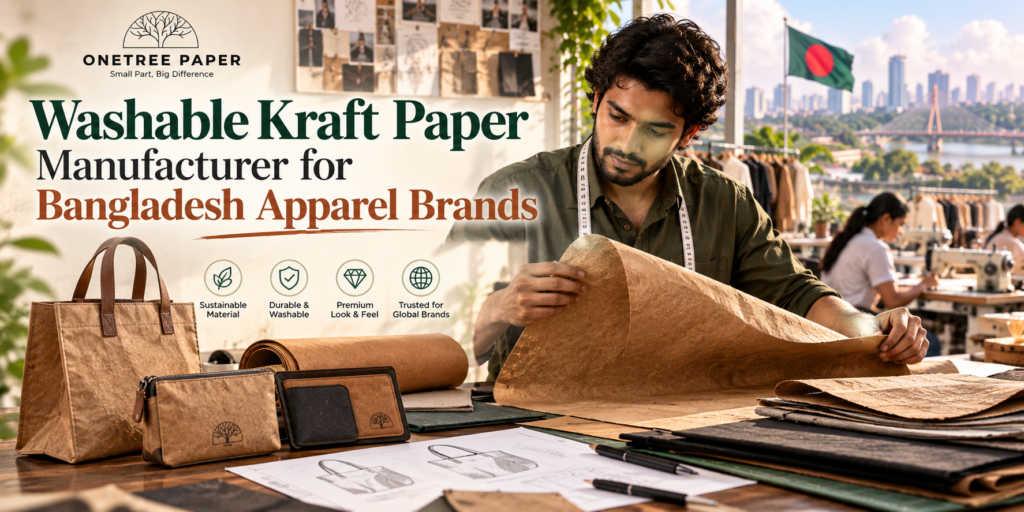
Did you know that a single pair of jeans can carry more packaging and labeling than most buyers ever notice? Now multiply that by millions of garments leaving Bangladesh each year.
Every hangtag, patch, and bag adds up. Plastic labels and virgin paper strain forests and landfills. Buyers in Europe and North America now ask tougher questions about materials.
So where do you start? With a trusted washable kraft paper manufacturer for Bangladesh apparel brands. This guide shows you how to choose one, what to test, and what to avoid. You will also learn how eco friendly paper protects trees and cuts waste.
Use this guide as a checklist. Each step is short and practical.
What Is Washable Kraft Paper?
Washable kraft paper is a paper-like material made mostly from cellulose fibers. Makers treat it so it survives water, soap, and machine washing. It feels like paper or soft leather. It does not turn to pulp in the wash.
Regular kraft paper is strong but tears when wet. The washable version stays flexible and durable. That makes it useful for garments, not just boxes.
How Washable Kraft Paper Is Made
The process has a few main stages:
- Pulp preparation: Makers use wood pulp or recycled fiber.
- Sheet forming: The pulp becomes thin, strong sheets.
- Treatment: Special coatings or fiber blends add wash resistance.
- Finishing: The sheet is softened, pressed, and cut to size.
Quality depends on fiber source, treatment, and process control. This is why your choice of manufacturer matters so much.
Where Apparel Brands Use It
You can use washable kraft paper in many places:
- Sewn-in patches on jeans, caps, and bags
- Care labels and brand labels
- Hangtags that survive customer washing
- Garment bags and tote bags
- Decorative trims for fashion and streetwear
- Swing tags for premium collections
Brands like it because it looks natural and tells a clear sustainability story.
Why Bangladesh Apparel Brands Are Making the Switch
Bangladesh is one of the world’s largest garment exporters. The ready-made garment sector drives a very large share of the country’s export income. With that role comes pressure from global buyers.
Buyer Demands Are Rising
International buyers now set material rules. Many ask for:
- Lower plastic use
- Recycled or responsibly sourced content
- Clear supplier documents
- Chemical safety proof
Regulations in Europe push the same direction. Brands that ignore this risk lost orders. Brands that adapt win trust.
Sustainability Pays Off
Switching to sustainable paper products is not only about rules. It also brings real business value:
- Stronger brand story with customers
- Easier buyer approvals during audits
- Less plastic in your supply chain
- Better shelf appeal with a natural look
Quick insight: Customers read labels. A paper label that says “made from recycled fiber” builds trust faster than a long sustainability report.
The Environmental Impact of Paper
To see why this choice matters, look at the environmental impact of paper. Paper starts as trees. Making it uses water, energy, and chemicals.
What Paper Production Costs the Planet
- Forests: Millions of trees are harvested each year for paper and pulp.
- Water: Pulp and paper mills use large amounts of water.
- Energy: Drying and pressing sheets takes heavy energy.
- Waste: Paper is a large share of landfill material in many places.
When forests shrink, the planet loses carbon storage, wildlife homes, and clean air. That is why tree saving paper matters.
Recycled Paper Benefits
Recycled paper benefits the environment in several clear ways:
- Saves trees by reusing fiber instead of cutting new wood
- Uses less energy than making paper from raw pulp
- Uses less water in many production setups
- Cuts landfill waste by giving paper a second life
- Lowers carbon output in many cases
Paper fiber can be recycled several times. Each cycle keeps material in use and out of the trash. Exact savings vary by mill and process, so always ask suppliers for data.
Plastic vs. Paper Labels
| Feature | Plastic or Synthetic Labels | Washable Kraft Paper |
|---|---|---|
| Raw material | Fossil-based | Plant-based fiber |
| Recycled content | Rare | Often possible |
| End of life | Persists for long periods | Can be recycled or biodegrade |
| Buyer perception | Increasingly questioned | Positive, natural |
| Look and feel | Smooth, synthetic | Warm, leather-like |
| Wash durability | High | High (when well made) |
Washable kraft paper gives you strength without the heavy plastic footprint. Always confirm the exact composition with your supplier.
How to Choose a Washable Kraft Paper Manufacturer: Step by Step
Finding the right washable kraft paper manufacturer for Bangladesh apparel brands takes a clear process. Follow these eight steps.
Step 1: Define Your Use Case
Start with the end product. A jeans patch needs more strength than a hangtag. Write down:
- Product type (patch, label, tag, bag)
- Wash cycles needed (for example, 20 or more)
- Water temperature
- Print method (laser, emboss, screen)
- Order size and timeline
A clear brief saves weeks of back-and-forth.
Step 2: Check Material Quality
Ask for the technical sheet. Look at these points:
- GSM (weight): Higher GSM feels thicker and stronger.
- Tear strength: Measures how well it resists ripping.
- Thickness: Affects sewing and feel.
- Fiber source: Virgin pulp, recycled pulp, or a blend.
Do not accept vague answers. A good manufacturer shares numbers.
Step 3: Run Real Wash Tests
Never trust a claim without a test. Request samples and wash them yourself.
- Sew or attach samples to a test garment.
- Wash at your target temperature.
- Repeat for the number of cycles you need.
- Check for fraying, color loss, peeling, or shrinking.
Test with the same detergent and dryer your customers use. Real conditions reveal real quality.
Step 4: Verify Sustainability Credentials
Words like “eco-friendly” mean little without proof. Ask for documents such as:
- FSC or similar certification for responsible forestry
- Recycled content statements
- Chemical safety reports (for example, REACH or OEKO-TEX tests, where relevant)
- Factory audit information
If a supplier avoids documents, move on.
Step 5: Confirm Chemical Safety
Garments touch skin. Your labels must be safe. Ask whether the paper and coatings are free of restricted substances. Request test reports from recognized labs. This protects your customers and keeps buyer audits smooth.
Step 6: Compare MOQ, Pricing, and Lead Time
Cost matters, but look at the full picture.
- MOQ (minimum order quantity): Can they serve small and large runs?
- Pricing: Is it clear and consistent?
- Lead time: Can they meet your shipping dates?
- Sampling speed: How fast do you get a test batch?
A slightly higher unit price may save money if quality is steady and delivery is on time.
Step 7: Evaluate Customization Options
Good manufacturers offer flexibility:
- Custom colors and finishes
- Embossing and debossing
- Laser engraving
- Custom thickness and softness
- Cut-to-size or die-cut shapes
Match options to your brand look.
Step 8: Check Logistics and Support for Bangladesh
Shipping time and customs can slow production. Ask about:
- Shipping routes to Dhaka or Chattogram
- Import paperwork support
- Local agents or reps
- Communication speed and language support
Fast, clear communication prevents costly delays.
Specs to Compare Before You Order
Use this table to compare suppliers side by side.
| Specification | What to Ask | Why It Matters |
|---|---|---|
| GSM / Weight | What is the exact GSM? | Affects strength and feel |
| Wash cycles | How many cycles passed testing? | Shows real durability |
| Fiber source | Virgin, recycled, or mixed? | Links to tree saving impact |
| Certifications | FSC, OEKO-TEX, or others? | Builds buyer trust |
| Color fastness | Does color bleed or fade? | Protects garment quality |
| Print compatibility | Laser, emboss, screen? | Ensures brand logo clarity |
| MOQ | What is the smallest order? | Controls early costs |
| Lead time | Sample and bulk timelines? | Protects delivery dates |
Print this table and keep it with your supplier notes.
Common Mistakes to Avoid
Many brands lose time and money by making simple errors. Avoid these:
- Skipping wash tests. Samples look good dry but fail in the machine.
- Choosing on price alone. Low cost often means low quality.
- Ignoring documents. Missing certificates can delay shipments.
- Overlooking recycled content. You may miss a strong sustainability story.
- Forgetting end-of-life. Ask what happens after the garment is discarded.
- Ordering bulk too early. Always approve a pre-production sample first.
How OneTreePaper Supports Tree Saving and Sustainable Paper
Choosing a paper partner with a clear environmental mission adds real value. OneTreePaper focuses on sustainable paper products and promotes tree saving paper solutions for businesses.
Here is how a sustainability-focused paper brand like OneTreePaper contributes:
1. Promoting Recycled and Responsible Fiber
Using recycled fiber reduces the need to cut new trees. When brands choose recycled-content paper, they directly support forest protection. OneTreePaper encourages this shift by offering paper options built around lower-impact sourcing.
2. Reducing Waste Across the Supply Chain
Smart paper choices help reduce paper waste. That includes right-sized labels, less offcut waste, and materials that can be recycled after use. OneTreePaper’s approach centers on practical solutions that fit real production needs.
3. Spreading Environmental Awareness
Education matters as much as products. OneTreePaper works to raise awareness about the environmental impact of paper, helping brands and consumers see why small material choices make a big difference.
4. Supporting Brands With a Clear Story
Apparel brands need proof to share with buyers. A sustainability-focused partner helps you explain where materials come from and why they matter.
Tip: When you contact OneTreePaper or any supplier, ask for specific product specs, certifications, and sample kits. Verify every claim with documents before you place a bulk order.
How to Reduce Paper Waste in Your Garment Factory
Choosing the right supplier is one part. The rest happens on your factory floor. Use these simple habits to reduce paper waste.
Plan Your Cutting
- Use digital layouts to cut label and tag waste.
- Order near your real need to avoid overstock.
- Store sheets flat, dry, and clean.
Reuse and Recycle
- Collect paper offcuts in labeled bins.
- Send clean scraps to recycling partners.
- Reuse backing sheets and cartons where safe.
Go Digital Where You Can
- Use digital tech packs instead of printed copies.
- Share approvals by email or cloud tools.
- Print on both sides when you must print.
Train Your Team
Short training sessions help workers see why waste matters. Share simple targets, such as “cut offcut waste by 10% this quarter.” Small goals build lasting habits.
Build a Sustainable Office Setup
Your office also counts. Try these quick wins:
- Switch to recycled office paper.
- Add clear recycling stations.
- Replace single-use items with reusable ones.
- Track monthly paper use and share results.
The Bigger Picture: Why Every Tree Counts
Forests clean the air, store carbon, protect soil, and shelter wildlife. Bangladesh is also highly exposed to climate risks such as floods and cyclones. Protecting green cover supports communities and long-term economic stability.
Every label, tag, and bag you switch to eco friendly paper is a small step. Across thousands of factories and millions of garments, small steps become real impact.
Think about it this way:
- One decision to use recycled fiber saves wood.
- One factory that cuts waste saves money and resources.
- One industry that moves together reshapes the global supply chain.
Your choice of washable kraft paper manufacturer for Bangladesh apparel brands is part of that shift.
Key Takeaways
- Washable kraft paper gives apparel brands a strong, natural, plastic-light label option.
- Choose a manufacturer with proven wash tests, certifications, and chemical safety reports.
- Recycled paper benefits include saved trees, lower energy use, and less landfill waste.
- Compare suppliers on GSM, wash cycles, fiber source, MOQ, and lead time.
- Reduce paper waste in your factory with better planning, recycling, and digital tools.
- Partners like OneTreePaper support tree saving paper goals and environmental awareness.
- Always verify claims with documents and real samples before bulk orders.
Frequently Asked Questions
What is washable kraft paper made of?
It is mainly made from cellulose fibers, often from wood pulp or recycled paper. Makers treat the sheets so they resist water and survive washing. Exact blends differ by manufacturer.
Can washable kraft paper really go through a washing machine?
Yes, when it is well made. Quality varies, so always run wash tests with your own samples. Check for fraying, peeling, and color loss.
Is washable kraft paper eco friendly?
It can be. Plant-based fiber and recycled content make it a lower-impact option than many synthetic labels. Ask for certifications and recycled content data to confirm.
How does recycled paper save trees?
Recycled paper reuses existing fiber, so fewer new trees are cut for pulp. It also often needs less energy and water than virgin paper. Savings depend on the mill and process.
What should I ask a washable kraft paper manufacturer before ordering?
Ask about GSM, wash cycle results, fiber source, certifications, chemical safety tests, MOQ, lead time, and shipping to Bangladesh. Request samples first.
Is washable kraft paper good for export garments from Bangladesh?
Yes. Many global buyers want lower plastic use and cleaner materials. Washable kraft paper helps you meet those goals when it has proper test reports.
How can I reduce paper waste in my garment business?
Plan label orders carefully, recycle offcuts, use digital approvals, and train your team. Choose sustainable paper products with recycled content.
What is the environmental impact of paper?
Paper production can affect forests, water supplies, and energy use. Using recycled, responsibly sourced paper lowers that impact.
Conclusion: Choose Paper That Protects Your Brand and the Planet
Picking the right washable kraft paper manufacturer for Bangladesh apparel brands is a smart business move and an environmental one. You gain a strong, natural material. Your buyers gain trust. The planet gains saved trees and less waste.
Remember the core steps. Define your use case. Test every sample. Verify certifications. Compare specs. Plan to reduce paper waste at every stage. Choose partners who care about tree saving paper and honest sustainability.
Ready to make the switch? Contact OneTreePaper today to request samples, ask about recycled and washable options, and start building a greener label line for your brand. Every tree you save begins with one smart choice.